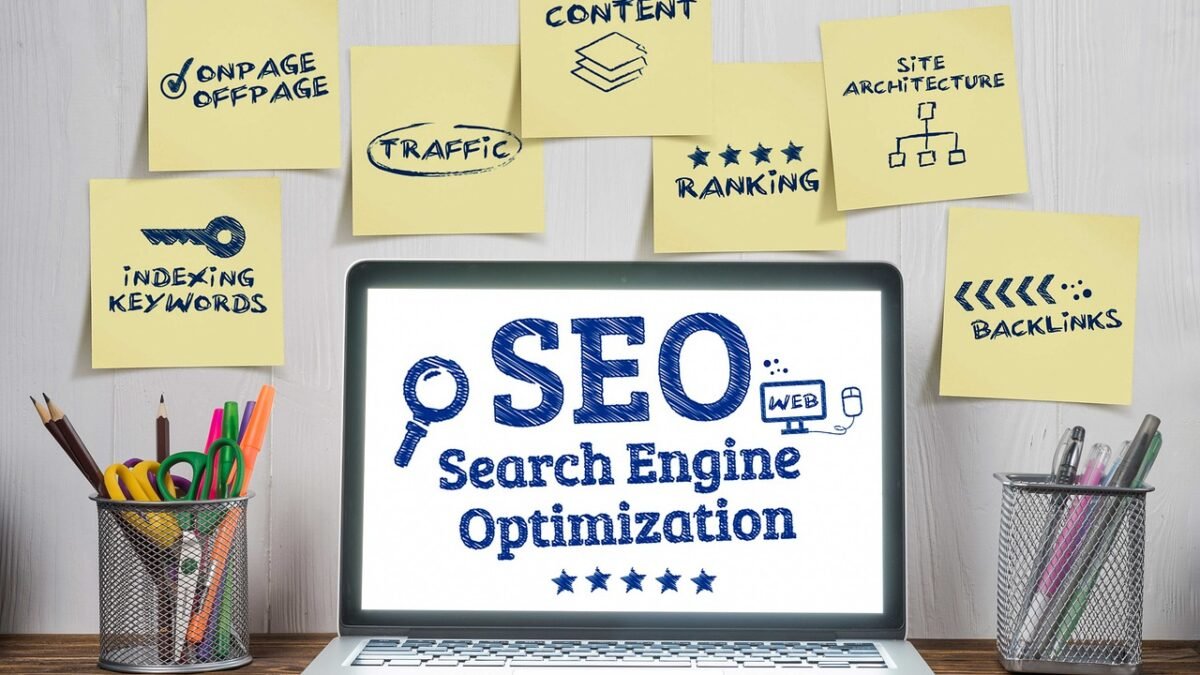
Semantic SEO is the practice of creating content around the meaning, intent, and context of a search — not just repeating an exact keyword. It extends keyword research by adding clear topic coverage, intent alignment, accurate entity information, and coherent internal linking. Keywords still matter. Descriptive wording in titles, headings, and body copy helps users and search systems understand what a page covers. Semantic optimisation adds meaning, context and structure that can help users and search systems understand whether a page satisfies the intended task.
- Semantic SEO extends keyword research — it does not replace it. Words users search for still belong in prominent page locations.
- Google uses multiple language-understanding systems (including neural matching and BERT) that can interpret concepts and context, but does not publish a “semantic SEO score” or required concept list.
- Topical authority is a practitioner framework, not a published Google metric. It describes consistent, coherent subject coverage — not article count or domain-level probability scores.
- Structured data helps describe page content and supports eligibility for rich results. It does not create expertise or guarantee improved rankings.
- A semantically optimised page covers the concepts necessary for its specific intent — not every concept associated with the broader subject.
- People-first content guidance from Google focuses on helpfulness and reliability — not “semantic richness” as a separate ranking signal.
- Common failure modes include intent dilution from over-expansion, cannibalisation from overlapping pages, and structured data that misrepresents page content.
Semantic SEO is the practice of creating and organising content around the meaning, intent, and context behind a search — not merely repeating an exact keyword. It combines keyword research with clear topic coverage, accurate terminology, relevant entity information, and a logical content structure.
This does not mean keywords have stopped mattering. Google’s Search Essentials still recommends using the words people search for in prominent locations such as titles, headings, alt text, and link text. (Google Search Essentials) The difference is that modern optimisation cannot stop at phrase placement. A page must also satisfy the user’s underlying task and explain the concepts needed to complete it.
Google uses several language-understanding systems to interpret concepts and context in queries and pages. However, Google does not publish a “semantic SEO score,” a required list of related terms, or a universal topical-authority metric. Semantic SEO is best treated as a practitioner framework for producing clearer, sufficiently complete and better-organised content for a defined search task — not as a disclosed Google ranking formula.
What “Semantic” Means in Search
Semantics is the branch of linguistics concerned with meaning. In search, semantic understanding refers to a system’s ability to:
- Understand query intent — distinguish between “jaguar” the car, “jaguar” the animal, and “Jaguar” the operating system without the user specifying which they mean
- Understand document meaning — determine what a page is about beyond the literal words it contains
- Match intent to content — surface pages that satisfy the user’s underlying need, even when they do not contain the exact query string
Google’s ranking-systems documentation confirms that neural matching helps Google understand representations of concepts in queries and pages and match them. BERT is described as an AI system Google uses to understand how combinations of words express different meanings and intent. (Google Ranking Systems Guide)
Google Search uses multiple systems — crawling, indexing, retrieval, ranking, quality evaluation, and language understanding — not one unified semantic algorithm. The table below reflects what Google has documented about each system alongside the industry context where first-party sources are limited.
| System | Evidence-based description |
|---|---|
| RankBrain (2015) | An AI system that helps Google understand how words relate to concepts, allowing it to identify relevant content even when that content does not contain every exact word used in the query. (Google Ranking Systems Guide) |
| BERT (2019) | An AI system Google uses to understand how combinations of words express different meanings and intent. (Google Ranking Systems Guide) |
| MUM (2021) | A multilingual and multimodal AI model designed for complex information-understanding tasks; applied selectively in Search features, not a universal ranking algorithm. (Google MUM announcement) |
These systems have made phrase repetition a less reliable strategy. But they operate alongside link signals, freshness, quality systems, and many other ranking factors. Semantic optimisation can improve how clearly a page communicates its relevance, but it does not replace link, quality, freshness or other ranking considerations.
Semantic SEO Does Not Replace Keywords
The most important framing correction before going further: semantic SEO extends keyword research. It does not make keywords irrelevant.
Google’s Search Essentials advises site owners to use the words their audience would use to find their content and place those words in prominent locations — titles, headings, alt text, and link text. Semantic understanding by Google’s systems does not eliminate the role of descriptive wording. (Google Search Essentials)
What semantic optimisation changes is the content strategy:
| Keyword-led approach | Semantic approach |
|---|---|
| Starts with one target phrase | Starts with a search task and query group |
| Focuses on wording placement | Focuses on meaning, intent, and relationships |
| May create separate pages for keyword variants | Consolidates variants that share the same intent |
| Measures individual keyword rankings | Measures query groups, organic traffic, and outcomes |
| Risks density-based writing | Risks over-expansion without intent boundaries |
The failure mode of keyword-only SEO is writing for phrase repetition rather than user tasks. The failure mode of semantic SEO applied incorrectly is covering every possible related concept on one page, creating intent dilution and excessive length.
The Four Practical Components of Semantic SEO
1. Search Intent Alignment
Search intent describes the underlying task or purpose behind a query. The same surface-level query can represent different intents:
“Best running shoes” could mean:
- Comparison shopping across models (the most common format in many markets; check current SERPs for your target query and location)
- Guidance on what makes a running shoe suitable for a specific use
- Confirmation of a specific model before purchase
Search result composition provides evidence about what formats and page types currently satisfy a given query. That composition can change and should not be treated as a permanent classification.
| Query need | Likely page type |
|---|---|
| Learn a concept | Definition or guide |
| Compare options | Comparison page |
| Choose a product | Category or buying guide |
| Complete an action | Product, service, or tool page |
| Troubleshoot a problem | Diagnostic or how-to page |
A page that mismatches the dominant intent is unlikely to compete consistently for the primary query, regardless of how thoroughly it covers a different interpretation of the topic. Intent alignment is a prerequisite for topical coverage to matter.
2. Necessary Topic Coverage
Topical coverage means explaining the concepts a reader needs to complete the page’s specific task — not every concept associated with the broader subject.
Running shoes — semantic coverage in practice:
A beginner’s guide to choosing running shoes should cover: shoe types by surface (road, trail), key fit factors (toe box, arch support, sizing), drop height if relevant to the buyer’s decision, and when to replace worn shoes. It should not also cover competitive racing shoe technology, carbon fibre plates, or podiatric biomechanics — those belong on pages with different search intents and audiences.
Apply a coverage decision for every potential subtopic:
| Include on this page | Create a separate page |
|---|---|
| Necessary to answer the main query | Represents a distinct search task |
| Provides context for a user decision | Requires substantial independent depth |
| Clarifies a named entity or concept | Targets a different funnel stage |
| Resolves an expected follow-up question | Would make this page unfocused |
Google’s people-first content guidance focuses on helpfulness and reliability for an intended audience. It does not identify comprehensiveness, word count, or length as independent quality signals. (Creating Helpful, Reliable, People-First Content) Content length should follow the task — some queries require depth, others are satisfied by a concise answer, a product page, or a definition.
3. Entity and Relationship Clarity
An entity is a real-world thing with a distinct identity — a person, place, organisation, concept, product, or event. Google’s Knowledge Graph organises information about recognised entities — such as people, places, organisations and concepts — and relationships among them. Google does not publish a complete model explaining how an individual page contributes to entity recognition or ranking.
Google’s structured-data documentation says structured data can help it understand page content and gather information about people, organisations, and other things. (Introduction to Structured Data in Google Search)
Use accurate Schema.org types that describe the visible content, and follow Google’s documentation where a specific Search feature is supported. Depending on the page, this may include Organization, Product, Article, LocalBusiness, or ProfilePage markup containing a Person or Organization entity.
What structured data does:
- Helps Google understand the content of specific page elements
- Supports eligibility for relevant rich results
- Can help disambiguate entity identity information
What structured data does not do:
- Guarantee entity recognition or Knowledge Graph inclusion
- Create expertise or topical authority by itself
- Produce ranking improvements independent of content quality
A technical page should identify the correct organisations, datasets and tools where they are necessary to explain the subject accurately. For example, a Core Web Vitals guide may identify CrUX as a field-data source and PageSpeed Insights as a diagnostic interface. Do this to improve factual clarity and verification — not to increase an assumed entity count or ranking signal.
4. Internal Information Architecture
Google’s documentation confirms that crawlable links help it discover pages and that anchor text can help users and search systems understand what linked pages cover. (Google SEO Link Best Practices) Topic clusters — pillar pages linked to related sub-topic pieces — are one useful architecture pattern for organising related content and internal links. They are not the only valid structure, and they do not produce a guaranteed topical-authority ranking effect.
Use internal links to:
- Connect genuinely related content across the cluster
- Create navigation pathways for users researching a topic
- Avoid orphan pages with no internal path
- Use descriptive anchor text that accurately reflects the destination page
This article connects to the rest of the Semantic SEO cluster: How Google’s NLP, BERT, and MUM Work covers the language-understanding systems referenced above in detail; Topical Authority in SEO examines what the practitioner framework does and does not claim; Entity SEO and Knowledge Graph Optimisation covers structured data implementation; Search Intent Optimisation covers intent classification and content format decisions; and Semantic Internal Linking covers architecture patterns in depth.
Topical Authority as a Practitioner Framework
Topical authority is an SEO term used to describe the perceived strength and consistency of a website’s coverage within a subject area. Google does not publish a topical-authority score or a domain-level probability metric. It evaluates page quality, relevance, source reputation, and other signals when ranking content.
Common misconceptions that should be avoided:
“40 articles are more authoritative than one comprehensive article.”
More pages do not equal more authority. Forty weak, overlapping, or thin pages may perform worse than one excellent, well-organised page. The advantage of broader content coverage depends on quality, intent coverage, internal organisation, source reputation, and user value — not article count.
“Google develops a probability that a domain is authoritative for a topic.”
This is a plausible practitioner interpretation of observable ranking patterns, not a published Google mechanism. Treat it as a hypothesis, not a confirmed scoring system.
What the framework does describe accurately:
An established specialist publication may benefit from stronger reputation, relevant inbound links, audience recognition, and existing related content when ranking new articles in its subject area. Those characteristics can create meaningful advantages, but Google does not reduce them to one disclosed topical-authority score.
Plan content around useful page-level intent coverage and coherent site architecture rather than arbitrary cluster size. A topic cluster should reflect user journeys and content relationships — not a volume target designed to signal authority to an algorithm.
When Semantic SEO Becomes an Enterprise Problem
Semantic SEO shifts from a writing discipline to an operational challenge when multiple teams create overlapping content, taxonomies diverge across systems, product pages and editorial pages compete for the same intent, or internal linking cannot be managed reliably at scale.
At that point, the organisation needs content governance, clear ownership, brief templates, quality controls, and consolidation rules — not simply better individual articles. Organisations managing large content inventories also typically need to evaluate page cannibalisation systematically, govern structured-data consistency across templates, and define who is responsible for content-performance decline before it compounds into a visibility problem.
Semantic SEO Workflow
| Stage | Keyword-only approach | Semantic approach |
|---|---|---|
| Research | Select target phrase | Identify query, intent, entities, decisions, and related needs |
| Page planning | Place keyword in page elements | Define page purpose and necessary concept coverage |
| Writing | Repeat keyword variations | Explain relationships and answer the user’s task clearly |
| Architecture | Link for keyword anchor diversity | Connect related pages according to user journeys |
| QA | Check keyword density | Check accuracy, completeness, overlap, and extraction quality |
| Measurement | Track target keyword rank | Track query groups, page contribution, and conversions |
Measurement
Track these signals to evaluate semantic SEO performance:
- Relevant query-group visibility — track visibility across the intended set of semantically and commercially relevant queries, not the total number of queries for which the page receives any impression
- Non-brand impressions and clicks — evaluate discovery from relevant searches that do not contain the brand name, while reporting branded performance separately
- Organic conversions — measure meaningful outcomes attributed to or contributed by organic visits to the page, such as qualified leads, purchases, subscriptions or tool usage; include assisted contribution where the decision cycle is long
- Internal-link coverage — whether cluster pages are properly interconnected and accessible
- Cannibalisation — whether multiple pages compete for the same query and intent
- Content-performance decline — investigate losses in visibility or conversions before updating; causes may include changing intent, stronger competitors, technical issues, seasonality or declining demand, not only content age
- Generative AI search visibility — use available Search Console generative AI reporting to evaluate impressions, clicks and discovery through AI features; where separate citation analysis is available through validated tools or manual review, report it independently and disclose the methodology
- Indexation of intended pages — confirm that core cluster pages are indexable, indexed where appropriate and discoverable through internal links; investigate unnecessary crawl activity separately rather than treating more crawling as inherently better
Do not use “semantic keyword count” or third-party “semantic density scores” as primary KPIs. These are not Google signals.
Common Failure Modes
| Failure | Consequence |
|---|---|
| Covering every related concept on one page | Intent dilution and excessive length |
| Publishing one page for each keyword variant | Cannibalisation and maintenance overhead |
| Treating entity mentions as a density target | Unnatural, search-first writing |
| Adding schema that misrepresents page content | Structured-data policy risk |
| Building clusters without demand or user need | Low-value content inventory |
| Repeating generic definitions across multiple pages | Weak information gain across the site |
| Using word count as a proxy for quality | Padded, derivative content |
| Generating AI-written tangential sections | Off-intent pages with no verified search demand |
Semantic SEO for AI Overviews and AI Mode
Google’s guidance on optimising for generative AI features states that foundational SEO practices remain relevant and that no special markup or separate optimisation process is required for AI Overviews or AI Mode. (Google’s Guide to Optimizing for Generative AI Features)
Clear definitions, accurate facts, focused sections, visible supporting evidence, and coherent site structure make content easier to understand and reuse across search experiences — including AI-generated summaries.
The same practices that make content useful for a reader make it useful for AI extraction: direct answers at the top of sections, accurate entity identification, fact-source attribution, and non-overlapping page structure. The goal is not to write for a language model. It is to write clearly and accurately for the user who asked the question.
What Semantic SEO Is Not
Not a synonym-insertion strategy. Search systems can recognise many synonyms and related expressions, so manually forcing every variation into the copy is unnecessary. Use the terminology your audience expects where precision matters.
Not long-form content for its own sake. A concise page that fully satisfies the query can outperform a longer page padded with repetition. No specific word count guarantees a ranking outcome.
Not a replacement for links and source reputation. Google confirms that links help with both page discovery and relevance understanding. (Google SEO Link Best Practices) Third-party metrics such as Domain Authority are estimates — not Google scores. Semantic optimisation improves the content signal; it does not compensate for a domain with no external credibility.
Not a reason to avoid keywords. Descriptive words in titles, headings, body copy, alt text, and links remain important because they communicate what a page covers to users and search systems. Semantic optimisation supplements accurate wording with context, intent alignment, and relationship clarity.
Evidence Boundary
What Google officially confirms:
- Language-understanding systems including neural matching and BERT help Google interpret concepts and context in queries and pages
- Structured data can help Google understand page content and describe entities
- Helpful, reliable, people-first content is recommended
- Words users search for should appear in prominent page locations
- Links help Google discover pages and understand relevance
- Foundational SEO practices apply to AI search features including AI Overviews
Practitioner frameworks in this article (not published Google metrics):
- Semantic SEO as a content strategy framework
- Topical authority as a subject-coverage quality concept
- Topic clusters as an architecture pattern
- Semantic neighbourhoods as a content-planning model
- Entity optimisation as a content and structured-data approach
What Google does not publish:
- A semantic SEO score or semantic-completeness metric
- A topical-authority metric or domain probability score
- A required entity count or related-term list per topic
- A minimum word count or length-based ranking advantage
- A universal content-cluster formula
- A separate AI-optimisation process distinct from standard SEO
Primary Sources
- Google Search Essentials — Use of search terminology in prominent page locations
- Google Ranking Systems Guide — Neural matching, BERT, RankBrain descriptions
- Understanding Searches Better Than Ever Before — Google’s BERT announcement
- Introducing MUM — Google’s MUM scope and description
- Creating Helpful, Reliable, People-First Content — People-first content guidance
- Introduction to Structured Data in Google Search — Structured data scope and function
- Organization Structured Data — Organisation identity markup
- ProfilePage Structured Data — Profile page markup for Person and Organization entities
- Google SEO Link Best Practices — Links for discovery and relevance
- Google’s Guide to Optimizing for Generative AI Features — AI Overviews and AI Mode guidance
- How Google Search Works — Technical overview of Google Search systems
Summary
Semantic SEO extends keyword research by focusing on the meaning and task behind a query. It helps content teams decide which concepts to explain, which entities to identify, which related pages to connect, and which tangents to exclude.
Effective semantic optimisation does not require adding every related term, producing the longest article, or publishing dozens of cluster pages. It requires a focused page that answers its intended question accurately, uses recognisable language, explains necessary relationships, and connects users to the next relevant resource.
Google confirms that its systems can understand concepts and context beyond exact phrase matching, but it does not publish a semantic-completeness score, topical-authority metric, or required entity list. The safest strategy is to optimise for user clarity, intent satisfaction, factual accuracy, and coherent site structure — while continuing to use search terminology naturally.
Next in this cluster: How Google’s NLP, BERT, and MUM Work: What SEOs Need to Understand
Semantic SEO extends keyword research by focusing on search intent, topic coverage, entity clarity, and internal architecture. Google does not publish a semantic SEO score or topical-authority metric. This guide explains what semantic SEO is, how it differs from keyword-led optimisation, and how to apply it without common failure modes such as intent dilution and cannibalisation.