
– AI search generates answers from retrieved sources using LLMs — it does not rank and return links
– Four major platforms dominate in 2026: Google AI Overviews, ChatGPT Search, Perplexity, and Microsoft Copilot — each with different retrieval systems, LLMs, and citation interfaces
– No universal AI search algorithm exists; optimization for one platform does not guarantee visibility on others
– The SEO target shifts from “rank at position 1” to “be cited as a source”
– Claims about how AI search works internally vary widely in evidential basis — this article distinguishes what is documented, observed, and inferred
- AI search synthesizes answers from multiple sources; traditional search returns ranked links for users to read themselves
- No single AI search algorithm governs all platforms — Google, ChatGPT Search, Perplexity, and Copilot each use different retrieval systems and LLMs
- Ranking #1 does not guarantee citation — AI systems select sources based on comprehensiveness, structure, and authority, not position alone
- Content that is factually precise, well-structured, and source-backed is more commonly cited across platforms
- Most claims about how AI search systems work internally are observed or inferred — not documented by the platforms themselves
AI search refers to search engines that use large language models (LLMs) to generate direct answers to queries rather than returning ranked lists of links. Instead of presenting ten results and leaving users to read and synthesize information themselves, AI search engines retrieve relevant sources, synthesize information from them, and produce a generated response — often without requiring the user to click through to any external page.
In 2026, AI search is no longer a niche experiment. Google AI Overviews appear on a significant percentage of informational queries. ChatGPT Search processes hundreds of millions of queries monthly. Perplexity has established a meaningful presence among research-oriented users. Microsoft Copilot is integrated across Windows, Edge, and Microsoft 365 applications. The search landscape has fragmented in a way that has no precedent since Google consolidated search market share in the early 2000s.
This article explains what AI search is, how it differs from traditional keyword-based search at an architectural level, and what that difference means for how content gets discovered and cited. Every technical claim in this article is labelled by its evidence basis — see the framework at the end of this introduction.
Important note on evidence standards: AI search is an active, fast-moving area. Public documentation from Google, OpenAI, Perplexity, and Microsoft covers some mechanisms but not others. This article consistently distinguishes between what is documented by the platform, what is observed by practitioners, and what is inferred from behaviour. See the Documented / Observed / Inferred framework section.
| Traditional Search | AI Search |
|---|---|
| Returns a ranked list of links | Returns a synthesized answer |
| User reads and synthesizes sources | AI synthesizes sources for the user |
| Position 1–10 ranking model | Citation-based inclusion model |
| Single-turn query matching | Multi-turn conversational context |
| Click-through required for full information | Answer often complete without clicking |
| Deterministic results for same query | Probabilistic — same query can produce different answers |
How Traditional Search Works
Traditional search is a retrieval and ranking system. When a user submits a query, the search engine:
- Parses the query using natural language processing to identify keywords, entities, and intent
- Retrieves candidate documents from the index — pages that contain the query terms or semantically related content
- Ranks candidates using hundreds of signals: PageRank and link equity, content relevance, freshness, E-E-A-T indicators, page experience metrics
- Presents a ranked list of URLs with title tags and meta description snippets
- Leaves synthesis to the user — the user reads multiple results and constructs their own answer
The key characteristic: traditional search presents pointers to information. It does not interpret, summarize, or synthesize. The user does that work.
How AI Search Works
AI search adds a generation layer on top of retrieval. The broad architectural pattern — which applies in different specific implementations across platforms — runs as follows:
User Query → Query Parsing → Source Retrieval → Context Assembly (RAG) → LLM Generation → Citation → Synthesized Answer
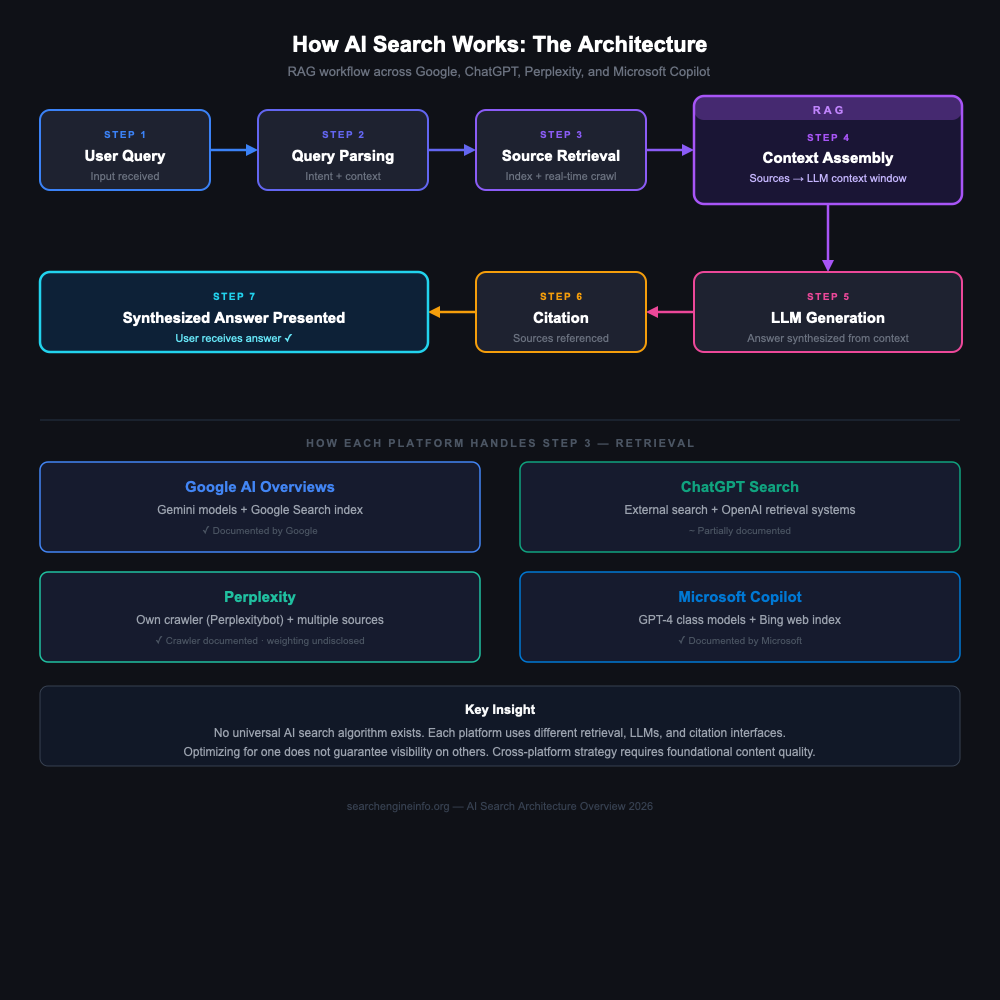
- Query parsing — with richer conversational context handling than traditional search (multi-turn conversations, pronoun resolution, implicit references)
- Retrieval — relevant sources are fetched from an index, real-time crawl, or a combination
- Context assembly — retrieved sources are assembled into a context window that the language model can read; this process is commonly called Retrieval-Augmented Generation (RAG)
- Generation — the LLM generates a response by synthesizing information from the assembled context across multiple sources
- Citation — sources used in generation are referenced, either inline or as a reference list, depending on the platform’s interface
- Presentation — the generated answer appears prominently, with cited sources available
The fundamental difference from traditional search: AI search generates a new piece of text based on retrieved sources rather than surfacing those sources directly. This is why the same query can produce different answers at different times — models update, sources change, retrieval results vary — and why a source can influence an answer without the user ever clicking through to it.
There is no universal AI search algorithm. Google, ChatGPT, Perplexity, Copilot, and other platforms each implement this architecture differently, with different retrieval systems, different LLMs, different citation interfaces, and different quality controls. Optimizing for one does not guarantee performance across the others.
The Major AI Search Platforms in 2026
Google AI Overviews
Google’s AI search integration — previously called Search Generative Experience (SGE) during its 2023 testing phase. Google has stated that AI Overviews are powered by Gemini models together with Google’s search systems, as documented in its Search and Gemini product announcements.
Google AI Overviews frequently cite pages that already perform well organically, but the relationship is not one-to-one. Google has not published the complete retrieval and citation-selection process for AI Overviews, and cited sources may include pages beyond the highest traditional rankings. Strong traditional SEO visibility often increases the likelihood of being surfaced as a potential source, but Google has not stated that high organic rankings are the sole or primary requirement for AI Overview citation.
AI Overviews are not shown for all queries. They are more common for complex informational queries (“what is,” “how to,” “why does,” comparisons) and less common for transactional and navigational queries.
ChatGPT Search
OpenAI integrated real-time web search into ChatGPT with a native feature for Plus and Pro subscribers. ChatGPT Search retrieves current web information through external search infrastructure and OpenAI’s own retrieval systems. Public documentation does not describe every component of the retrieval pipeline. OpenAI has stated partnerships and search infrastructure in product announcements but has not published the complete retrieval architecture.
ChatGPT Search presents answers conversationally with inline citations and a source list. Its users are typically conducting research or seeking explanations rather than quick informational lookups. Comprehensive and well-structured content is more commonly observed among cited sources, although OpenAI has not published detailed ranking criteria for citation selection.
Perplexity
Perplexity is purpose-built as an AI search engine — unlike ChatGPT Search, which is a conversational AI with search added on. Perplexity crawls the web independently (Perplexitybot is identifiable in server logs) and does not rely on a single index. Perplexity operates its own crawling infrastructure while also drawing on multiple retrieval sources. The exact weighting of those sources has not been fully disclosed publicly.
Perplexity’s interface explicitly presents a search interface: users submit queries, Perplexity retrieves real-time web sources, generates an answer with inline citations, and surfaces “Related Questions” for follow-up exploration.
Microsoft Copilot
Microsoft Copilot integrates GPT-4-class models with Bing’s web index — a combination Microsoft has documented across its Copilot product announcements. It is accessible through Bing.com, the Edge browser sidebar, the Windows 11 taskbar, and Microsoft 365 applications. The Windows taskbar integration, available to hundreds of millions of Windows users by default, gives Copilot significant passive exposure.
Because Copilot relies heavily on Bing’s web ecosystem, practitioners generally treat Bing crawlability as an important prerequisite for Copilot visibility, although Microsoft has not published detailed citation-selection criteria. Sites not properly crawled and indexed by Bing may be underrepresented regardless of content quality.
Other Platforms
Google AI Mode (a more conversational, agentic version of AI Overviews), You.com, Brave Search’s Summarizer, and AI integrations in Safari are all active AI search surfaces in 2026. The total AI search ecosystem is fragmented across more platforms than any practitioner can fully optimize for simultaneously — which makes foundational content quality the most defensible cross-platform strategy.
Platform Comparison
| Platform | Primary Strength | Key Differentiator |
|---|---|---|
| Google AI Overviews | Search augmentation | Largest query volume; tight organic-search integration |
| ChatGPT Search | Conversational research | Strongest conversational context; research-oriented users |
| Perplexity | Source-first research | Independent crawler; citations as first-class feature |
| Microsoft Copilot | Microsoft ecosystem integration | Windows/Office integration; Bing index dependency |
What Is Documented, Observed, and Inferred
Because AI search systems are proprietary, not all claims about how they work have equal evidential standing. The table below shows how to interpret claims in this article and the broader AI search cluster:
| Evidence Type | Description | Example |
|---|---|---|
| Documented | Stated by the platform in official announcements, research papers, or product documentation | Google AI Overviews use the Gemini model; Perplexity operates its own crawler (Perplexitybot) |
| Observed | Consistently reported by practitioners, researchers, or analytics data — not officially confirmed | Topically authoritative sites frequently appear in AI citations; AI Overviews cite pages that rank organically |
| Inferred | Reasonable conclusions from architecture knowledge, behavior patterns, or first principles — not confirmed | Bing crawlability affects Copilot representation; semantic precision aids LLM citation accuracy |
| Unknown | Not publicly disclosed by the platform | Full citation-selection criteria for any major AI search platform |
Every major technical claim in this article falls into one of these categories. When reading other AI search coverage — including vendor-published guides and practitioner posts — applying this framework prevents confusing speculation for fact.
How AI Search Differs From Traditional Search: Key Distinctions
1. Generation vs Retrieval
Traditional search retrieves and ranks existing content. AI search generates new content based on retrieved sources. This distinction changes what “appearing in search” means:
In traditional search, your exact content appears in the snippet. Users read your words. Your URL receives the click if they want more.
In AI search, the model synthesizes content from multiple sources and presents a new text. Your content may influence the answer, but users may read synthesized text that does not match your phrasing. Your URL may appear as a citation — whether users click through depends on whether the generated answer fully satisfies their need.
2. Click-Through Behavior
Traditional search drives clicks when users need to read the source for full information. AI search reduces clicks when the generated answer fully satisfies the query.
Multiple industry studies have observed lower click-through rates on some informational queries where AI-generated summaries appear. The magnitude varies by query type, industry, and study methodology. Navigational queries (looking for a specific site), transactional queries (looking to buy), and complex research queries continue to drive substantial click-through even when AI answers are present. Simple factual queries — definitional, procedural, or single-fact — see the greatest observed reduction.
3. How Sources Are Selected
Traditional search ranks sources primarily by link equity, content relevance, and page experience signals. AI search citation appears to favor a different — though overlapping — set of characteristics.
The following are observed patterns among frequently cited content. They are not documented ranking criteria published by any platform:
- Sources consistently recognized as authoritative within their topic area
- Content comprehensive enough that the LLM can extract answers to multiple sub-questions
- Structured information — explicit definitions, tables, numbered steps, and clear section headers — that is easy to extract and attribute
- Recently updated content on time-sensitive topics
- Precise, consistent terminology rather than keyword-variation synonyms
Google has not published the full weighting of these signals for AI Overview citation. OpenAI, Perplexity, and Microsoft have similarly not published complete citation-selection criteria.
4. Ranking Model vs Citation Presence
Traditional search uses a ranking model: pages are ordered 1 through 10 by relevance and authority. Position 1 is most prominent and receives the most clicks.
Many AI search systems present cited supporting sources rather than a traditional ranked list, although interfaces differ considerably across products. Some systems show inline citations, some show expandable source panels, some show hidden retrieval with no visible citations. The presence or absence of citation — and how prominently a source is featured — varies by platform and interface version.
For practitioners, this shifts the optimization question from “how do I climb from position 3 to position 1?” toward “how do I become a source this system cites at all?”
5. Conversational Context and Multi-Turn Queries
Traditional search treats each query independently. AI search handles conversation: a user can ask “what is Core Web Vitals?” and follow up with “which one matters most for e-commerce?” without repeating context. The AI search engine maintains the conversation thread and resolves the follow-up in context.
This changes how users formulate queries — AI search users tend to ask longer, more conversational questions, phrased as they would ask a knowledgeable colleague. Content that answers questions in natural, complete sentences with clear sub-question structures is a widely observed optimization pattern for AI search citation, rather than a documented ranking requirement.
Uncertainty and Probabilistic Generation
AI search systems are probabilistic. The same query submitted twice may produce different answers. The same source may be cited in one response and absent from another. LLMs do not retrieve the same documents deterministically — retrieval results vary, and the generation process itself introduces variation.
This has practical implications:
- Measuring AI search performance requires repeated sampling, not single-point observation
- A source being cited once does not guarantee ongoing citation
- Model updates, index changes, and prompt changes can shift citation patterns without notice
- AI systems can generate plausible-sounding incorrect information even when citing a source — the cited source may not actually support the generated claim
Practitioners tracking AI search visibility should treat citation rate (percentage of queries on which a domain is cited) as a more meaningful metric than whether a single query cites a specific page.
What AI Search Means for Content Discovery
The shift from retrieval to generation changes which content gets discovered and how. Based on observed citation patterns — not documented platform criteria:
Content more commonly observed in AI citations:
– Comprehensive guides covering a topic completely enough that LLMs can extract answers to multiple sub-questions
– Factually precise content with explicit definitions, specific numbers, and named sources
– Content with clear structure — section headers matching common question phrasings, tables and lists that are easy to extract
– Domains consistently recognized for coverage of a topic area
– Primary research, proprietary data, and original analysis not available from other sources
Content less commonly observed in AI citations:
– Thin content that makes one point and stops
– Content that buries the key point — AI systems extract answers; content where answers appear early and clearly is more commonly cited
– Visual information (charts, infographics) without text equivalents — LLMs primarily process text
– Generic content that closely matches widely available information
The SEO Response: GEO (Generative Engine Optimization)
GEO — Generative Engine Optimization — refers to the practice of optimizing content to be cited and accurately represented in AI-generated search answers. It is an extension of SEO, not a replacement.
The following practices are commonly associated with stronger AI citation visibility. They are observed patterns, not documented requirements from any platform:
- Cite primary sources explicitly — content that cites original research and official documentation is consistently observed among cited sources in AI answers
- Define terms clearly and early — explicit early definitions are commonly extracted by AI search systems for definitional queries
- Structure content around sub-questions — FAQ sections, numbered explanations, and header-demarcated sub-topics appear to be easier for LLMs to parse and cite
- Use consistent, precise terminology — avoiding synonyms used purely for keyword variation may improve how accurately LLMs represent the content
- Build topical coverage at domain level — domains consistently publishing substantive material on a topic area are more commonly observed among cited sources, though the mechanism is not fully disclosed by any platform
GEO implementation, citation signal analysis, tracking AI search performance, and emerging standards like llms.txt are covered in depth in the AI SEO & GEO cluster.
Common Misconceptions About AI Search
❌ AI search replaces SEO
AI search still retrieves from web indexes and crawls the web. Sites that perform well in traditional search have a higher baseline citation probability across most platforms. The optimization target shifts — it does not disappear.
❌ GEO is a separate discipline from SEO
GEO extends SEO, not replaces it. Technical accessibility, authoritative content, structured data, and link equity all underpin both. GEO adds citation-readiness criteria — structured answers, explicit definitions, source-backed claims — on top of existing SEO foundations.
❌ AI search always cites the #1 ranking page
Citation behavior differs by platform and query. Google has not documented that AI Overviews exclusively cite top-ranked pages. Observed patterns show AI systems frequently cite pages across a range of ranking positions, with content quality, comprehensiveness, and structure being more commonly associated factors than raw position.
❌ Optimizing for one AI platform covers all of them
Each platform — Google, ChatGPT Search, Perplexity, Copilot — uses different retrieval systems, different LLMs, and different citation interfaces. Strategies confirmed on one cannot be assumed to transfer to others.
❌ Disappearing clicks means SEO is dead
Click behavior varies by query type. Simple informational queries see the greatest impact from AI-generated answers. Navigational, transactional, and complex research queries continue to drive meaningful click-through even when AI answers are present. AI search changes the click distribution — it does not eliminate search traffic.
Internal Links
- How LLMs Retrieve, Process, and Cite Information from the Web — RAG architecture, crawler access, context window mechanics
- What Is GEO? — Generative Engine Optimization defined
- AI Search Ranking Factors — observed citation signals across platforms
- How to Track AI Search Visibility — measurement methodology
- llms.txt: What It Is and Whether It Matters — the emerging standard for LLM content instructions
Primary Sources
- Google AI Overviews: blog.google/products/search/generative-ai-google-search-may-2023
- Google Gemini in Search: blog.google/products/search/google-search-generative-ai-learning-2023
- OpenAI ChatGPT Search announcement: openai.com/index/introducing-chatgpt-search
- Microsoft Copilot documentation: learn.microsoft.com/en-us/copilot/overview
- Perplexity crawler (PerplexityBot): docs.perplexity.ai/guides/perplexitybot
Summary
AI search adds a generation layer on top of traditional retrieval. Instead of ranking links, AI search engines synthesize answers from multiple sources and present generated text with citations. The major platforms in 2026 — Google AI Overviews, ChatGPT Search, Perplexity, and Microsoft Copilot — each use different retrieval systems, different LLMs, and different citation interfaces. There is no universal AI search algorithm, and optimization for one platform does not guarantee performance across others.
For content creators and SEOs, AI search shifts the target from “rank at position 1” to “be cited as a source.” The overlap with traditional SEO is substantial — authoritative, comprehensive, well-structured content performs well in both systems — but AI search places additional weight on factual precision, explicit source citation, semantic consistency, and clear structure.
Every claim about how AI search systems work internally should be evaluated against whether it is documented by the platform, observed in practice, or inferred from behaviour. This distinction matters because practitioner decisions based on speculation can misallocate significant optimization effort.
Traditional search helps users find documents. AI search helps users obtain answers. Success therefore shifts from simply ranking pages to becoming a trusted source that AI systems are willing to retrieve, synthesize, and cite.
Next: How LLMs Retrieve, Process, and Cite Information from the Web — RAG architecture, context windows, and what determines which content an LLM extracts when constructing an answer.
TL;DR – AI search generates answers from retrieved sources using LLMs — it does not rank and return links – Four major platforms dominate in…